


Charity – the cure for an embarrass de richesses?
There are increasing numbers of millionaires in Britain today. Research from Barclays Wealth-X has found that there are now 715,000 millionaire living in the UK, compared with 508,000 in 2010. The number of billionaires has also doubled in the last five years.
According to estimates by The Sunday Times Rich List in 2015, the collective wealth of Britain’s richest 1,000 people now stands at a staggering £547 billion; a figure which has doubled itself in the last ten years despite the decade-long recession caused by the global economic crisis.
Many of these individuals give large amounts to good causes they are passionate about. In fact, the sector is increasingly reliant on big givers, so with all this richesse around, you might expect that charities have done rather well out of increased giving from those able to ride out the recession. In reality, however, that hasn’t been the case. Tracking million-plus donations over the years, the Coutts’ Million Pound Donors Report shows that major gifts to charity slumped during the economic crisis and have yet to top pre-recession levels.
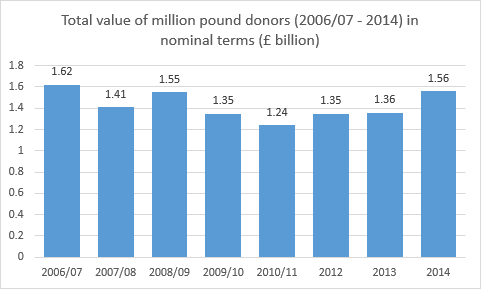
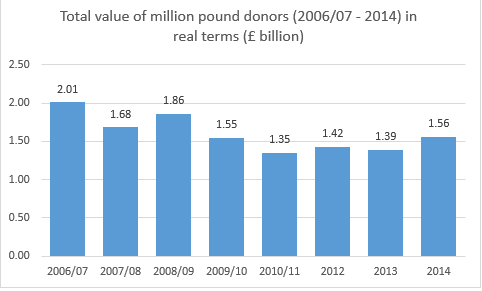
In fact, when you look at the gift totals adjusted for inflation it’s clear that present-day giving has a long way to go to get back to where we were ten years ago. Especially when you take into account the fact that just over half of the £200m rise in 2014 was the result of a single gift of £105 million (from Hillside (New Media) Limited, to establish the Bet365 Foundation).
This finding is echoed in the annual Sunday Times Giving List (based on the giving of the 1,000 wealthiest people in Britain). An analysis of the figures by charity think tank, New Philanthropy Capital (NPC) showed that major donors are giving away a smaller percentage of their residual wealth in 2016 than previously. In 2015, philanthropists needed to give away at least 2.56% of their residual wealth to appear in the Sunday Times Giving List’s top 50, in 2016 this figure was 2.07%. This seems to indicate that while rich listees’ individual wealth has been increasing, their donations have stayed at the same level at a time when charities might feel they need an extra injection of cash most.
There has been much made in recent discussions of increasing inequality and of the fact that the very richest in our society have not been touched as much by the recent economic fluctuations, so why would big giving flounder at this time of greatest need?
One explanation may be purely psychological. The Barclays Wealth-X president recently commented that: ‘The great paradox of wealthy individuals which applies to all of us, is that they give based on the psychology of how they feel. So, while the market gyrations may in many cases not impact directly their net worth and they still have plenty of money to spend, they may 'feel' less well off or that their net worth is diminishing and this definitely will impact their philanthropic giving .’
Another reason has been put forward by Dr. Beth Breeze, author of Coutts’ Million Pound Donors Report, who talks about the ‘longstanding fears that gifts will be used to replace lost funding, rather than to enhance the public sphere’ .
So what can be done to encourage more big givers?
Philanthropist Matthew Bowcock (former chair of the UK Community Foundations and Arts Council Trustee) has recently launched an initiative called Giving More and Better, in a bid to boost UK giving by £4bn from the super-rich. Given that a key driver behind donor activation is referral by a trusted friend and/or advisor, this may help to encourage more wealthy people to become philanthropists, although similar ‘giving campaigns’ have failed to make a noticeable difference in this regard.
The Barclays Wealth-X research into why wealthy people give finds that a sense of purpose and personal fulfillment rank as top reasons for philanthropy. This ties in with research conducted in the UK which found that wealthy givers aspire to be a catalyst for change . So these are the things which charities need to supply in order to attract more big givers. But can such efforts really ensure more big gifts to charity? As we have seen, levels of big gifts tend to fluctuate. This may be because very large gifts tend to be made in response to life events such as selling a company or coming into an inheritance. So maybe it would be better to concentrate on getting more wealthy people to give, rather than concentrating efforts on getting that one major gift?
The good news is that this is already happening. The Coutts’ reports show that the number of million-plus donors to charity has been rising over the last ten years, and now stands at one third as many as in 2006/07 before the global recession. In 2015, just under one in five (178) of all those in The Sunday Times Rich List have donated at least £1m to charity in the past year.
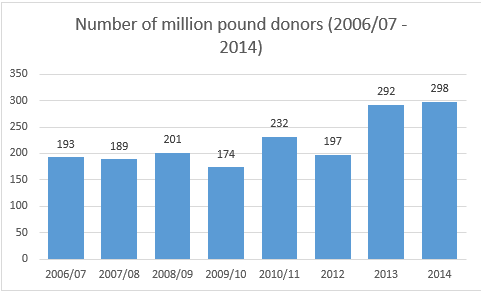
Hopefully this indicates a growing interest in giving among the rich, and that there will be more big gifts to come if these ‘nouveau riche philanthropists’ can be encouraged to keep giving.
[1] ‘Sense of purpose, personal fulfillment rank as top reasons for philanthropy’. Barclays Wealth-X research. Luxury Daily. March 28, 2016 (https://www.luxurydaily.com/sense-of-purpose-and-personal-fulfillment-rank-as-top-reasons-for-philanthropy/).
[1] This argument is also put forward in the context of the Brexit aftermath: ‘The Brexit Effect: What the Leave Vote means for UK philanthropy’ City Philanthropy (http://cityphilanthropy.org.uk/features/brexit-effect-what-leave-vote-means-uk-philanthropy).
[1] The Wealth-X attitudes survey surveyed more than 400 of the world’s leading private bankers and wealth advisors, who combined are responsible for the management of $500 billion belonging to 45,000 individuals.
[1] Beth Breeze & Theresa Lloyd, 2013. ‘Richer lives: Why rich people give’. DSC.